
The Contribution of Sundanese Ulama in the Maintenance of Pegon Script as an Islamic Intellectual Tradition in Indonesia
DOI:
https://doi.org/10.31291/jlka.v24i1.1376Keywords:
Islamic Intellectual Tradition, Southeast Asian Manuscript Tradition (Nusantara), Pegon Script, Sundanese UlamaAbstract
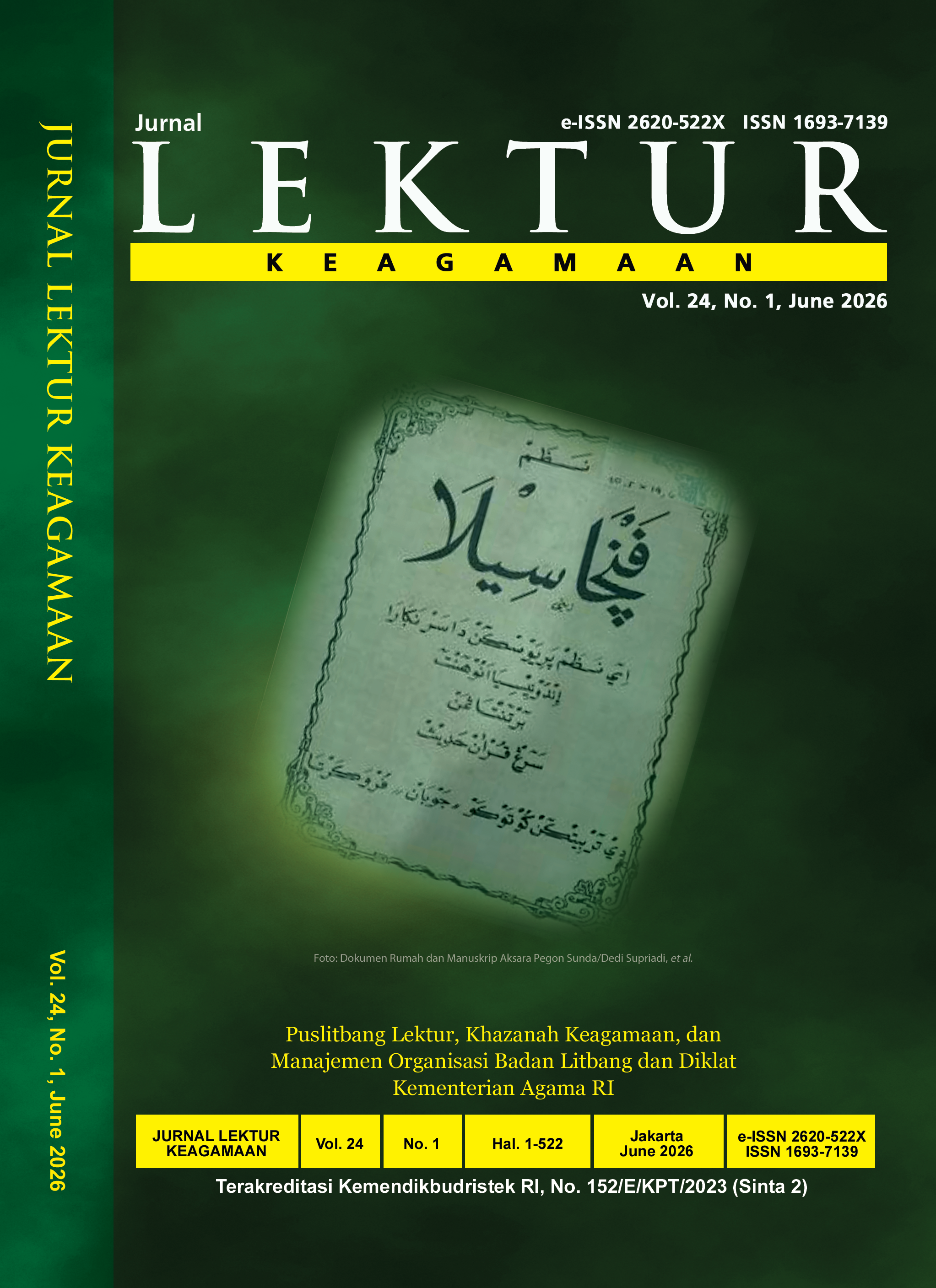
Although traditional Muslim scholars in the Nusantara (the Malay-Indonesian archipelago) have been widely studied for their roles in religious propagation, politics, and education, their contributions to the development of indigenous writing traditions remain insufficiently explored. Among the most significant yet understudied of these contributions is the Pegon script, an adaptation of Arabic letters systematically modified to transcribe local languages such as Sundanese and Javanese, which served as a primary vehicle for the production and transmission of Islamic knowledge across the region. Existing scholarship on Pegon manuscripts has predominantly concentrated on philological editing and textual criticism, while the role of Muslim scholars in shaping Pegon as a dynamic medium for transmitting Islamic knowledge and constructing cultural identity has received comparatively limited attention. This study employs historical and philological approaches, combined with critical discourse analysis, to examine Sundanese manuscripts written in the Pegon script, drawing on local historical narratives and archival sources. The findings demonstrate that Pegon functioned not merely as a writing system but as a multidimensional intellectual instrument: a pedagogical medium within ulama and pesantren networks, a cultural bridge connecting local and global Islamic traditions, and a subtle instrument of resistance to colonial authority. Taken together, these findings attest to the remarkable intellectual creativity of Sundanese ulama in developing an effective vernacular writing system and underscore the critical importance of manuscript studies in reconstructing the dynamics of Islamic intellectual history in Southeast Asia.
Downloads
References
Books
Al-Attas, Syed Muhammad Naquib. The Mysticism of Hamzah Fansuri. Kuala Lumpur: University of Malaya Press, 1970.
Azra, Azyumardi. Jaringan Ulama Timur Tengah dan Kepulauan Nusantara Abad XVII dan XVIII. Bandung: Mizan, 1994.
Azra, Azyumardi. The Origins of Islamic Reformism in Southeast Asia: Networks of Malay-Indonesian and Middle Eastern ʿUlamāʾ in the Seventeenth and Eighteenth Centuries. Honolulu: University of Hawaiʻi Press, 2004.
Bruinessen, Martin van. Kitab Kuning, Pesantren, dan Tarekat. Yogyakarta: Gading Publishing, 2012.
Bruinessen, Martin van. Tarekat Naqsyabandiyah di Indonesia. Bandung: Mizan, 1992.
Chittick, William C. The Sufi Path of Knowledge. Albany: State University of New York Press, 1989.
Fathurahman, Oman. Tarekat Syattariyah di Minangkabau: Teks dan Konteks. Jakarta: Prenada Media Group, 2008.
Gadamer, Hans-Georg. Truth and Method. New York: Continuum, 2004.
Iser, Wolfgang. The Act of Reading: A Theory of Aesthetic Response. Baltimore: Johns Hopkins University Press, 1978.
Izutsu, Toshihiko. God and Man in the Qurʾan: Semantics of the Qurʾanic Weltanschauung. Tokyo: Keio Institute of Cultural and Linguistic Studies, 1964.
Jauss, Hans Robert. Toward an Aesthetic of Reception. Minneapolis: University of Minnesota Press, 1982.
Nasr, Seyyed Hossein. Knowledge and the Sacred. Albany: State University of New York Press, 1989.
Rahman, Fazlur. Islam. Chicago: University of Chicago Press, 1979.
Rusydi, Ahmad. Matan al-Binā wa al-Asās. Jakarta: Jaya, n.d.
Al-Sinkilī, ʿAbd al-Raʾūf. Tarjumān al-Mustafīd. Singapore: n.p., n.d.
Tafsir, Ahmad. Filsafat Ilmu: Mengurai Ontologi, Epistemologi, dan Aksiologi Pengetahuan. Bandung: PT Remaja Rosdakarya, 2015.
Yafas, M. Perkembangan Thariqat Syathāriyyah dan Pengaruhnya dalam Pengamalan Ajaran Islam di Kecamatan Lintau Buo. Research report. Padang, 1990.
Zulkifli. Sufism in Java: The Role of the Pesantren in the Maintenance of Sufism in Java. Seri INIS XL. Leiden-Jakarta: INIS, 2002.
Manuscripts
ʿImrān, ʿAlī. Teks Tarekat Syattariyah. Manuscript. Pondok Pesantren Nūr al-Yaqīn, Padang Pariaman, n.d. Colophon dated July 6, 1999.
Al-Sinkilī, ʿAbd al-Raʾūf. Bayān Tajallī. Manuscript.
Al-Sinkilī, ʿAbd al-Raʾūf. Daqāʾiq al-Ḥurūf. Manuscript.
Al-Sinkilī, ʿAbd al-Raʾūf. Kifāyah al-Muḥtājīn ilā Mashrab al-Muwaḥḥidīn. Manuscript.
Al-Sinkilī, ʿAbd al-Raʾūf. Lubb al-Kasyf wa al-Bayān limā Yarāhu al-Muḥtaḍar bi al-ʿIyān. Manuscript.
Al-Sinkilī, ʿAbd al-Raʾūf. Tanbīh al-Māsyī. Manuscript.
Al-Sinkilī, ʿAbd al-Raʾūf. ʿUmdah al-Muḥtājīn ilā Sulūk Maslak al-Mufarridīn. Manuscript.
Journal Articles
Azwar, Welhendri, and Muliono. “The Multifaced Politics: A Study on Polarization of Political Behavior of Tarekat Community in West Sumatera, Indonesia.” Al-Jamiʿah: Journal of Islamic Studies 60, no. 2 (2022): 315–346. https://doi.org/10.14421/ajis.2022.602.315-346.
Fathurahman, Oman. “Itḥāf al-Dhakī by Ibrāhīm al-Kūrānī: A Commentary of Waḥdat al-Wujūd for Jāwī Audiences.” Archipel 81 (2011): 177–198. https://doi.org/10.3406/arch.2011.4274.
Fathurahman, Oman. “Reinforcing Neo-Sufism in the Malay-Indonesian World: Shaṭṭārīyah Order in West Sumatra.” Studia Islamika 10, no. 3 (2003): 29–93. https://doi.org/10.15408/sdi.v10i3.623.
Feener, R. Michael. “A Re-Examination of al-Raniri.” Bijdragen tot de Taal-, Land- en Volkenkunde 151, no. 4 (1995): 573–592. https://doi.org/10.1163/22134379-90003042
Feener, R. Michael. “A Re-Examination of the Place of al-Hallāj in the Development of Southeast Asian Islam.” Bijdragen tot de Taal-, Land- en Volkenkunde 154, no. 4 (1998): 571–592. https://doi.org/10.1163/22134379-90003885.
Mahmudi, and Ahsanul Anam. “The Javanese Mystical Epistemology in Kitab Primbon Betaljemur Adammakna and Its Implication to Inclusivism.” Teosofia: Indonesian Journal of Islamic Mysticism 13, no. 1 (2024): 115–132. https://doi.org/10.21580/tos.v13i1.20933.
Muttaqin, Ahmad. “Tasawuf dan Spiritualitas Islam Nusantara.” Teosofi 5, no. 1 (2015): 1–22.
Rivauzi, Ahmad. “Landasan Filosofis Pemikiran Tasawuf ʿAbd al-Raʾūf al-Sinkilī tentang Allah, Manusia, dan Alam.” Teologia 28, no. 2 (2017): 299–328. https://doi.org/10.21580/teo.2017.28.2.1451.
Rivauzi, Ahmad, et al. “Integrasi Epistemologi Sufi dan Kepatuhan Syariah: Model Pengarusutamaan Moderasi Islamisasi di Madrasah Tarbiyah Islamiyah, Indonesia.” Jurnal Ilmiah Syariah 24, no. 2 (2025): 311–330. https://doi.org/10.31958/juris.v24i2.15756. [Lengkapi semua nama penulis jika mengikuti Chicago bibliography secara ketat.]
Zakirman, Elva Mahmudi, and Shafwatul Bary. “Nukilan Al-Qurʾan dalam Naskah Tarekat Syekh H. Ali Imran Hasan Ringan-Ringan (2017–1926).” SUHUF 16, no. 1 (2023): 155–177. https://doi.org/10.22548/shf.v16i1.804.
Informants
ʿImrān, Shaykh ʿAlī. Murshid of the Syattariyah Order, Surau Nūr al-Yaqīn Pakandangan, Padang Pariaman, West Sumatra. Interviews by author, March 23, 2007, and May 1, 2012.
Kerajaan, Tuanku. Student of Shaykh ʿAlī ʿImrān and teacher of the Syattariyah Order, Surau Nūr al-Yaqīn Pakandangan, Padang Pariaman, West Sumatra. Interview by author, April 23, 2026.
Downloads
Published
Issue
Section
License
Copyright (c) 2026 Dedi Supriadi, Moeflich Hasbullah, Faisal Muhmoud Adam

This work is licensed under a Creative Commons Attribution-NonCommercial-ShareAlike 4.0 International License.